
Fort Mill City Directory Collections
Fort Mill historical research works through a countywide shelf, not a single municipal directory counter. The clearest confirmed Fort Mill volume is a Hill Directory Co. publication from 1962. York County Library and the Historical Center of York County both identify city directories among broader local-history holdings, but the research did not find an authoritative catalog listing a complete Fort Mill title-by-title run. Treat the table as an access map, and ask the holding institution to confirm a title, year, and call number before traveling.
| Collection | Years | Where Held | Access |
|---|---|---|---|
| Hill's Fort Mill City Directory | 1962 | Documented by Fort Mill History Museum; current holder not verified | Physical volume documented; ask the Museum or Historical Center about access |
| York County Library Local History Area | No authoritative Fort Mill directory run located | Main Library, 138 E. Black St., Rock Hill | Primarily in-library consultation; confirm title and year with the Local History desk |
| Historical Center of York County city directories | Run not published in the inspected source | Search Room, 210 E. Jefferson St., York | Non-lending, public by request; request exact collection details |
| Springs Bulletin digital collection | 1943-1983 | Winthrop University Digital Commons | Searchable online by keyword or name; context source, not a complete roster |
The absence of a published year run is meaningful. It does not prove there were no other directories, only that this research could not confirm their dates, publisher, scan status, or shelf location. Record the edition searched and any variant spelling used. That note can prevent a later researcher from mistaking an unsearched gap for a negative result.
Fort Mill's Documented 1962 Directory
The Fort Mill History Museum published a newsletter excerpt describing a physical Hill's Fort Mill City Directory 1962, copyrighted in 1962 by Hill Directory Co. The newsletter says the volume was found in a used bookstore. It does not establish that the Museum, Library, or Historical Center now holds the book, and it does not establish a continuing series. That small distinction matters when a researcher is trying to trace a family through several years.
The publisher's description identifies four parts: an alphabetical list of adult residents and firms, a classified business directory, a directory of householders arranged by street and number, and a numerical telephone directory. The published sample includes vacancies, facilities, stores, civic locations, and named professionals. Use that evidence to understand the shape of the book, not to assume every type of entry or every address appears in it. The Museum's history and research page is the appropriate route to ask whether the volume or related material can be consulted. Its home page lists 107 Clebourne Street, Wednesday through Saturday hours, 803-802-3646, and admin@fmhm.org; it does not conduct family genealogical research.
Fort Mill Library Directory Leads
York County Library's Local History Area at the Main Library in Rock Hill brings together county census material, newspaper microfilm, manuscripts, burial and cemetery indexes, church and land material, family histories, and estate-related sources. Bring a full name, spelling variants, an approximate date window, and the Fort Mill or York County connection. The service is designed for on-site consultation. Ask a Librarian can answer questions, but the Library does not undertake extensive individual family research.
The York County Library Local History page explains the in-library collection and remote database gateways.
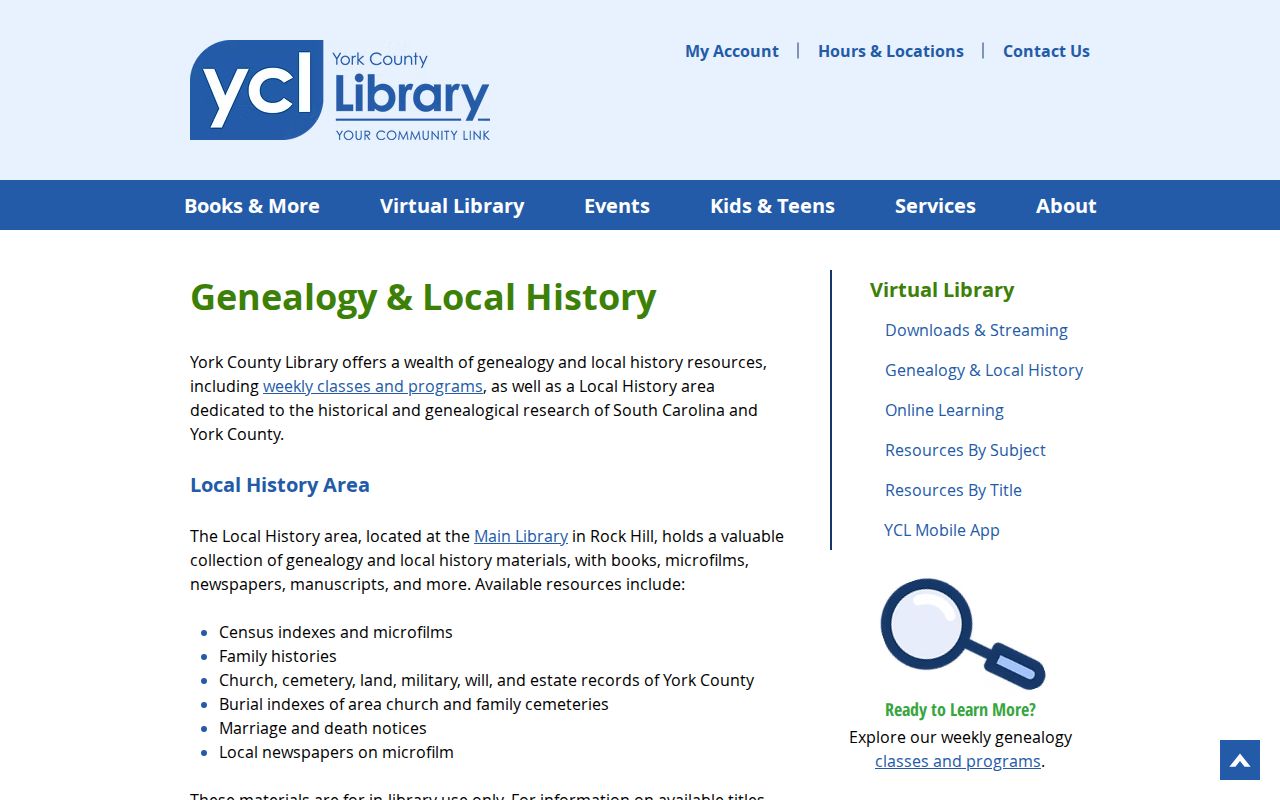
A library visit can connect an unverified city-directory mention with newspaper, cemetery, census, or manuscript evidence from the same county collection.
The general York County Library gateway is useful for checking current branch services before a visit.
Use the library catalog for call numbers when available, but do not treat a blank or incomplete catalog result as proof that no Fort Mill directory exists.
Fort Mill Collections at York Center
The Historical Center of York County is a second route for city directories, cemetery rosters, maps, surname files, school annuals, early will and deed abstracts, and late-nineteenth-century through 1980s newspapers. Its Search Room at 210 E. Jefferson Street in York is non-lending and available to the public by request. The Center also reports deed microfilm for 1785-1977 and directs researchers to the Register of Deeds for the 1977-83 gap, an access path rather than a promise that each document is online.
The Historical Center's public search-room page gives the current contact route, research fees, and collection description.
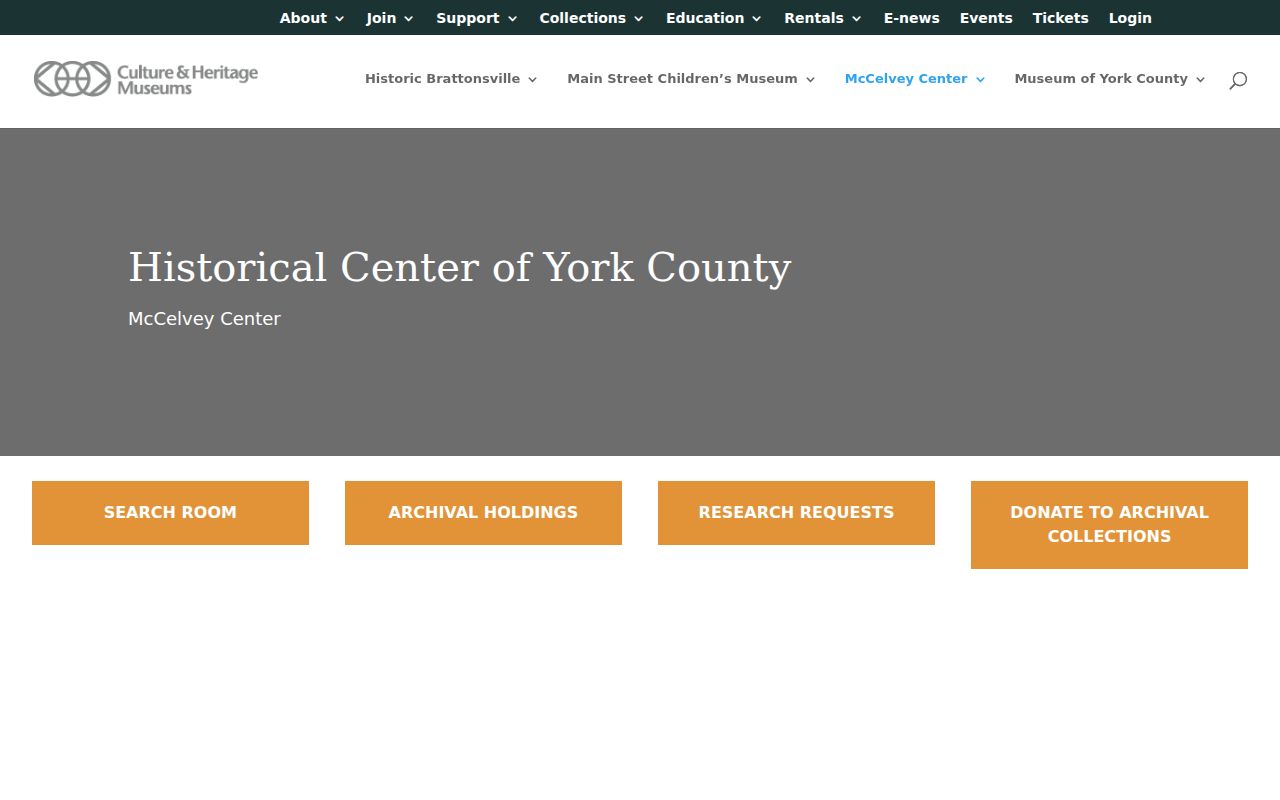
For staff help, send names with variants, approximate life dates, known places, and the question being tested. The Center's request form asks for first and last name, email, phone number, message, a numeric CAPTCHA answer, and submission. Its listed research charge is $10 for the first hour, $15 for later hours, plus 25 cents per copy.
The Center's Hart Collection covers more than 75,000 York County families compiled from the 1950s through the 1980s. It is a useful lead source, but the Center cautions that the compiler did not cite sources. Test any Hart lead against a dated directory, deed, probate record, census, or newspaper. Its on-site computers also provide access to Chronicling America and Newspapers.com for follow-up research.
Fort Mill Springs Directory Context
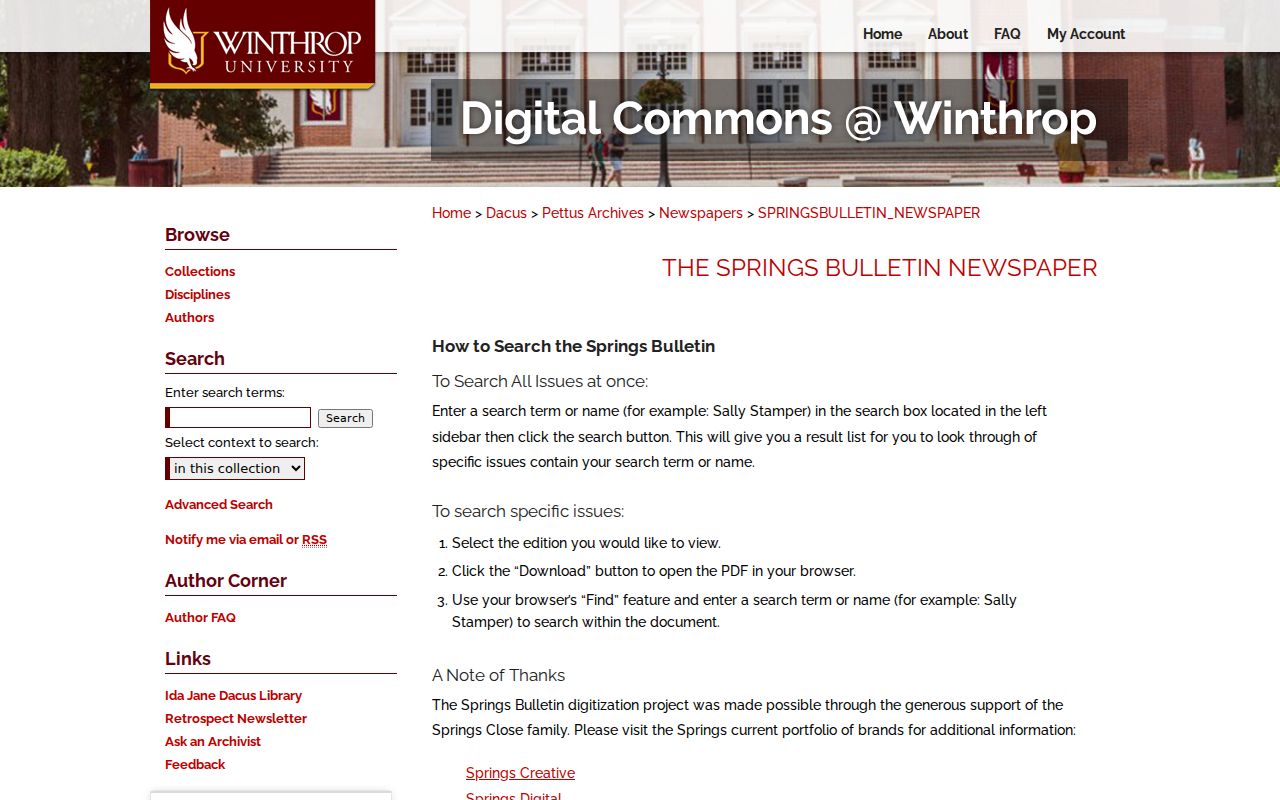
Not every historical name lead is a city-directory entry. Winthrop University's digitized Springs Bulletin is grouped for 1943-49, 1950-59, 1960-69, 1970-79, and 1980-83. Search a name or keyword, open the result issue, download the PDF, and use its Find feature to examine the occurrence in context. A mention can add community or place detail, but it is not a complete Fort Mill household list.
The Springs Bulletin digital collection supplies the searchable issue layer.
For original local archival material, the Spring Close Family Archives listing describes wills, deeds, plats, maps, correspondence, and Springs land material from 1764 to the present. It is appointment-only at 1042 West Highway 160 in Fort Mill, so request a collection or topic before going.
Reading Fort Mill Directory Entries
Read a directory entry as a dated lead. The documented 1962 volume's alphabetical portion was described as listing adult residents and firms with name, marital-status notation, occupation, address, and firm information. Its street-order householders section was described as streets and avenues in alphabetical order with number sequence, residences, and establishments. A numerical telephone entry is evidence of a number at that time, not a present contact route.
| Alphabetical list | Names, marital-status notation, occupation, address, and firm information as described for the 1962 volume. |
|---|---|
| Directory of householders | Street and avenue order with address numbers, residences, and establishments. |
| Classified section | Businesses and professionals under headings, useful as an institution or place lead. |
| Telephone section | Entries arranged by telephone number, usable only as time-specific contact evidence. |
- Criss-cross directory
- An address-first directory format. This research did not verify a Fort Mill criss-cross run, so confirm the edition before claiming one exists.
- Householder index
- A street-order listing that can connect a number with a recorded residence or establishment in the documented 1962 volume.
- Abbreviation key
- A volume-specific legend. Check the actual edition before interpreting shorthand; the inspected newsletter did not publish a key.
York District Records Before Fort Mill
Fort Mill was incorporated in 1873, while many earlier records are indexed under York County or York District. South Carolina's county-map guide notes counties from 1785-99, districts from 1800-68, then counties again after the 1868 Constitution. An older family search should use both York County and York District terms rather than expect a Fort Mill city record.
The South Carolina Department of Archives and History guide lists York conveyance books for 1786-1950, plats for 1908-50, probate estate files around 1787-1977, and other county series. These are historical record leads, not a single on-screen name index. Request a specific series, volume or reel, time range, and spelling variant. The Fort Mill directory is one useful bridge, not a replacement for those original records.
Tracing Fort Mill Directory Households
A sound household trail moves from a dated directory clue to an independent record. Start by writing down the exact name form, address, source, and year. If the 1962 Hill volume gives an address, compare it with a deed or plat only after matching the legal description or lot information. Ownership and a directory listing answer different questions, and neither alone proves every person in a household.
- Locate the earliest confirmed directory, newspaper, census, or bulletin mention.
- Copy the spelling, address form, date, and source location exactly.
- Check the documented householders or street-order section when the edition provides one.
- Pair the date with released census material, local newspapers, or an estate or deed record.
- Record what was searched when the name disappears, then test a move, death, variant spelling, or unlisted status with another dated source.
For the address-backward portion of the work, use the Fort Mill previous residents guide. It explains how to anchor an address to a tax map ID, legal description, and recorded-deed trail without recasting a historical collection as a current household list.
Fort Mill Postal Directory Clues
Older mailing clues need an address-level check. USPS moved 4,464 deliveries from 29715 to the new 29707 delivery area effective July 1, 2007. County address data also separates postal ZIP and community values from the municipality field. A Fort Mill mailing reference can therefore need confirmation against the specific street address, Town limits, and the date of the record.
This is especially useful when a directory, obituary, or bulletin mentions a postal place but not a clear land description. Preserve the original address wording first, then test it against a recorded plat, deed, or County address service rather than silently converting it to a present-day town label.